
Every successful Computer Software Assurance (CSA) program begins with understanding intended use. Before software risk can be assessed or assurance activities selected, manufacturers must first answer a deceptively simple question: What is the software actually intended to do?
It sounds straightforward, but this is where many organizations make their first mistake. Rather than evaluating individual software functions, they assess an application as a whole. That single decision can influence every step that follows—from risk determination and testing to documentation and long-term maintenance.
Intended Use Is More Than a Software Description
Many organizations describe intended use at the application level. While this may satisfy an inventory, it does not provide enough detail to support a risk-based assurance strategy. Modern software often performs dozens or even hundreds of functions. Some directly influence production or the quality management system (QMS), while others provide administrative or convenience features. Treating every function the same can result in inefficient validation or overlooked risks.
Evaluate Individual Software Functions
One of the most significant concepts within the FDA’s CSA guidance is evaluating software at the feature or function level. Rather than asking, ‘How should we validate this application?’, manufacturers should ask, ‘What functions of the software are we using, and does it support manufacturing or the QMS?’ Breaking software into individual functions allows assurance activities to be aligned with the actual risk presented by each function.
Direct vs. Indirect Software
Defining intended use also helps determine whether software supports production directly or supports the QMS. While both categories require appropriate validation, understanding the role each function plays provides the context needed for consistent risk assessments. Importantly, direct software should not automatically be considered high risk. Risk depends on the potential consequences of failure—not simply where the software is used.
How Intended Use Drives Every Other Decision
Once intended use is clearly defined, manufacturers can determine whether a function poses a high process risk, identify appropriate assurance activities, establish the level of documentation required, and leverage existing process controls where appropriate. A poorly defined intended use creates a chain reaction of poor decisions throughout the assurance process.
The Cost of Getting Intended Use Wrong
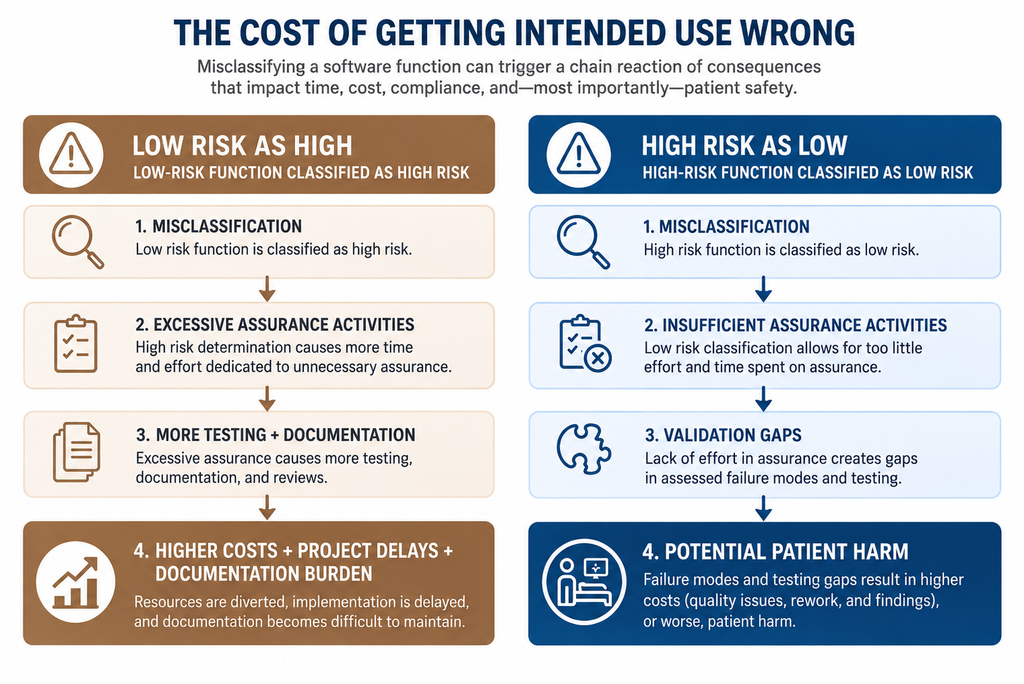
An incomplete assessment can create a chain reaction throughout the assurance process. Misclassifying a software function can result in either excessive or insufficient assurance activities, with consequences that compound as the project—and software—move forward.
Building a Consistent, Outcome-Based Evaluation Process
Organizations should establish a consistent, iterative process for defining intended use. That process should establish clear outcomes while allowing those performing the evaluation to apply critical thinking in how they get there. It should include identifying software features, documenting the purpose of each function, determining whether each function supports production or the QMS, and capturing the rationale behind those decisions. This approach improves both compliance and efficiency while making future software changes easier to evaluate.
Key Takeaway
Defining intended use is not simply the first step in Computer Software Assurance; it is the foundation on which every subsequent decision is built. When manufacturers take the time to understand software at the feature and function level, they can apply risk-based thinking with confidence, avoid unnecessary validation effort, and focus resources where they have the greatest impact on product quality and patient safety.
In the next article, we will build on this foundation by exploring the FDA’s expectations for software risk determination, why that distinction is central to selecting appropriate assurance activities, and how manufacturers can implement this approach in practice.
Missed our first blog in the series? Check it out here